
Jump inside the busy, messy middle

Justin Peek
Peek Wealth
It’s the end of summer in this glorious spot on the planet we call Carlsbad. I hope that you’ve been off enjoying our beaches, trails, lagoons, restaurants, and even other countries for a few weeks.
Recently, my family and I stopped off at South Ponto to dip our toes in the water before a dinner reservation. Seeing all the families on towels and under umbrellas and hearing the squeals of little ones splashing at the Pacific’s edge filled all of our hearts. We felt blessed.
It also jolted me with just how busy life had become off the beach, in what I call the messy middle.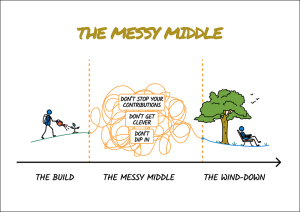
You see, working life tends to be split into three phases. There’s the early stretch, when you’re setting things up and putting your financial structure in place. There’s the final stretch, when you’re winding down towards retirement. Between these two phases, there’s the long middle stretch where most of life actually happens.
In this middle phase, the main work of building your financial structure is done. The accounts are open, and the contributions are running in the background. The investment strategy was chosen years ago and likely doesn’t need to be reinvented. From here on, your job isn’t to add something clever; it’s to leave the structure alone and let it do what it was designed to do.
Unfortunately, the temptation to interfere with a plan is strongest precisely during the stretch of life when such interference is most damaging.
The Busy, Messy Middle
The middle stretch of working life is demanding for many reasons. Careers are at full intensity. Kids are older and at their costliest, whether that’s school fees, college, or the years just before they leave home. Your aging parents are starting to need help in ways they didn’t before. Mortgages are real. Cars need replacing. A vacation that used to be frugal is now a major expense.
It’s also the stretch where you have the least bandwidth to think about the future. It’s a busy, busy phase, and money decisions get squeezed into the gaps between everything else, often made quickly and under pressure.
Because of the demands on your time, energy, and money, this phase of life is exactly when the structure you built is most at risk. And if you’re not working off an active, intelligent, and accurate financial plan or structure, this is also when that becomes obvious to you.
The Three Ways People Interrupt the Machine
We’ve seen families damage their financial lives in a variety of ways. But three specific actions show up time and again.
The first is to reduce or pause contributions. Life happens, and something has to give. The plan is always to catch up later, when things settle. In practice, we see that the contribution paused for a year often remains paused, and the compounding effect of that decision is lost forever.
The second is getting too clever. Well-meaning friends, and not-so-well-meaning media, describe a complicated structure that saves tax or an alternative investment that’s been performing well. In the moment, the tried-and-tested approach seems outdated, and the novel approach appears enticing. The temptation to optimize feels productive, especially when life elsewhere feels out of control. But the strategy you chose years ago was chosen for a reason, and tinkering with it now often adds cost and complexity without improving the outcome.
The third mistake is dipping into long-term investments for lifestyle expenses. It could be a renovation, a bigger car, or something that gives your child a head start over their peers. Each decision is defensible, yet the consequences for your long-term financial independence become a problem for your future self.
The Discipline of Restraint
Because the pressure to interfere is constant and the justifications are usually reasonable, restraint during this phase of life requires real discipline.
Consistent contributions and uninterrupted time during this “messy middle” are a major driver of financial independence later in life.
Perfect discipline is not always achievable, but this is what we encourage clients to aim for:
1. When money is tight, make your contributions the last thing you reduce, not the first.
2. When a new idea or investment comes up, ask whether it’s actually better than what you have, or just newer and more interesting.
3. When something tempting comes up that would require dipping in, ask whether the cost is worth what it might mean for your long-term plan.
If you’re in the busy, messy middle and you already have a financial plan in place, the most useful thing you can do is to get out of your own way. If something has come up that’s making you consider changing course, talk to your financial advisor before you do. At PEEK Wealth, we’re here to help. In most cases, the plan you committed to years ago is still the right one to stick with. And at the risk of belaboring the point, if you don’t have one of the active, intelligent, accurate financial plans incorporating your entire financial life… well, get on it! And let’s give you a head start. Scan the QR code to score how neat or messy your middle actually is. It’s free and confidential. Enjoy!